 UniqueizerPRO
Creative testing matrix: hooks × bodies
The usual reason a test teaches you nothing is that everything changed at once. Variant B won, but nobody can say what in it worked. A matrix fixes that: it separates the variables and multiplies them.
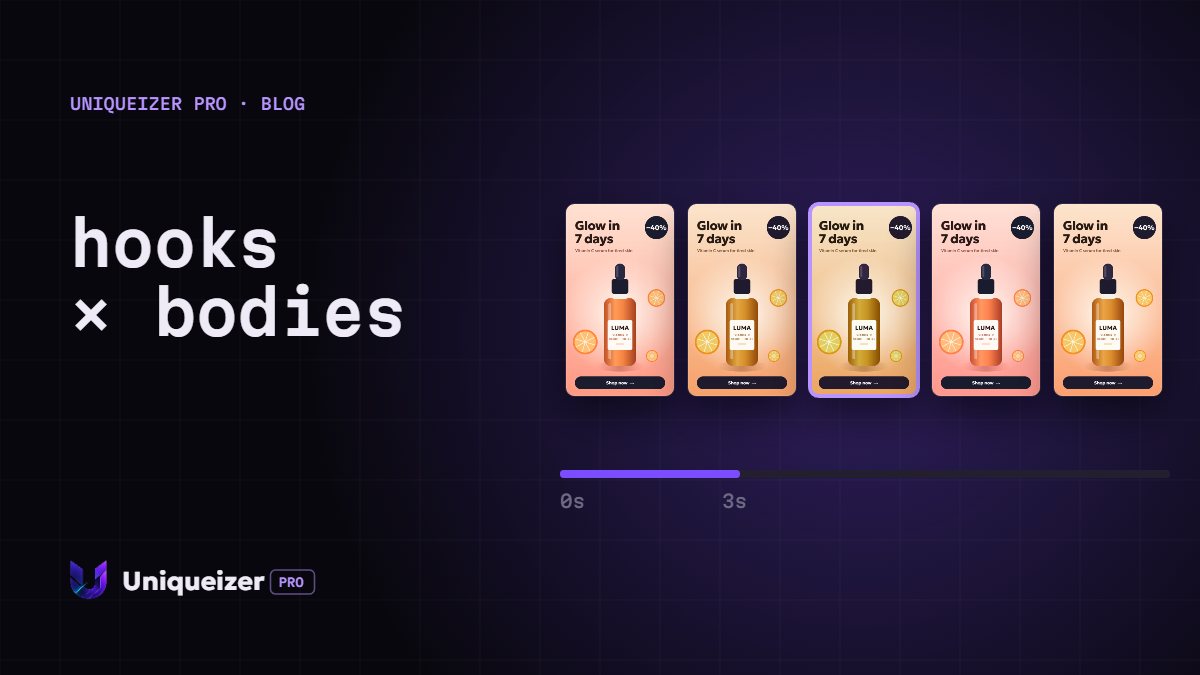
Split the creative into hook (first three seconds) and body (everything after). Test one axis at a time: hooks over one body first, then bodies over the winning hook.
Two axes
- Hook — the first three seconds. Decides whether the thumb stops;
- Body — everything else. Decides whether the offer lands.
They solve different problems and their metrics differ: the hook is judged by 3-second retention, the body by completion and clicks.
What the matrix looks like
| Body A | Body B | Body C | |
|---|---|---|---|
| Hook 1 | A1 | B1 | C1 |
| Hook 2 | A2 | B2 | C2 |
| Hook 3 | A3 | B3 | C3 |
Nine combinations is already too many for one budget. That is why the matrix is walked in two stages instead of all at once.
Two stages instead of nine ad sets
- Stage 1: hooks over a fixed bodyOnly the opening changes. Watch 3-second retention.
- Stage 2: bodies over the winning hookWatch completion and cost per result.
- Stage 3: consolidateMultiply the winning pair into rotation variants.
How many variants
Two variants is a coin toss: the difference almost always sits inside the noise. Three or four per axis is the working minimum, and they have to differ visibly — half a second of length is not a variable.
Common mistakes
| Mistake | What it costs you |
|---|---|
| Changed hook and body together | You have a winner and no explanation |
| Two variants instead of four | The difference is indistinguishable from noise |
| Different audiences per variant | You compared segments, not creatives |
| Stopped the test on day one | The decision was made on random numbers |
| Technically identical files | The platform may not treat them as separate |
On the last point, see why identical files hurt test cleanliness.
Questions people ask
Why can I not change everything at once?
You can, if you only want something that works. But you will not be able to repeat it on the next offer, because you will not know what worked.
How many variants per axis at minimum?
Three or four. With two, the difference almost always fits inside the margin of error.
How do I know the hook won?
By 3-second retention, not by clicks. Clicks depend on the offer as well.
Do I need all nine combinations?
Almost never. Two stages are enough.